

I am sure you have eaten at McDonalds at least once in your life or maybe just took a happy meal and ate at your comfort place. But have you ever wondered about the McDonalds’ classic “I’m Lovin it” sound?
YES, that is an example of sound mark.
Can Sound Be A Trademark?
If you have ever used a Nokia or Samsung phone, you must be familiar with the signature sound when you switch on the device. But do you have any idea that one can even register a sound as a trademark? Yes, an mp3 file can be the unique identifier for your brand if registered as a sound mark.
Imagine your brand has an attractive and unique logo with a distinctive sound, crazy?
Some sound mark examples are McDonald’s “I’m Loving it” and Airtel’s signature ringtone.
In this article, you’ll discover more about sound trademarks and how to register a sound mark for your own brand or company.
What Sounds Have Been Trademarked?
- Audi’s heart-beat sound logo.
- Federal Signal Q2B Siren
- The NBC Chimes
- Intel Inside Bong
- Mcdonalds’ “i’m lovin’it”
- Britannia (four-note bell sound)
- Airtel ringtone
- Lucasfilms THX Deep Note
- AAMCO Transmission – automobile repair – “Double A – TOOT TOOT – M C O”
- TWENTIETH CENTURY FOX – entertainment – cat’s meow
- ESPN – entertainment – sports programming – six musical notes
- Nokia and Samsung (switching on device sound)
- Mister Softee – ice cream trucks – musical jingle
- SPANISH COAST TO COAST – radio – music + “RADIO VARIEDADES”
- Yahoo (human voice saying hello)
- TC Entertainment -entertainment – a musical phrase
- MGM – Entertainment – Roaring Lion
- Al Ham Productions – Entertainment – The Dreams We Share, We’ll Always Remember, Remember With The Music Of Your Life “
- America Online – online multi-user computer sound mark “You’ve got mail”
- Beneficial – Insurance -” At Beneficial TOOT TOOT You’re Good for More…”
Smell Marks: Most Rare Trademarks in The World
Which Countries Allow Sound Trademarks?
- Australia (Under Trademark Act, 1995)
- China (Under China’s Standards for Trademark Review and Examination)
- UK (Under The Trademarks Act, 1994)
- India (Under Trademark Act of 1999)
- USA (Under Lanham Act)
- Canada (Under Trademarks Act of Canada)
- Japan (Under Trademark Act of Japan)
Sound Trademark Registration in the United States
In the United States, sound marks can be registered with the U.S. Patent and Trademark Office (USPTO) when they function as trademarks and meet the applicable registration requirements. Unlike India, the U.S. application process does not require a musical notation or graphical representation of the sound. Instead, applicants can submit an audio file along with a written description of the sound.
Requirements for Registering a Sound Trademark in the U.S.
To apply for a sound trademark in the U.S., applicants generally need to:
*- Submit an acceptable audio file of the sound, such as an MP3 file. The USPTO’s filing system also accepts certain other audio formats, subject to its file requirements.
*- Provide a clear written description identifying the sound and explaining what it consists of.
*- Identify the specific goods or services with which the sound is used.
*- Select an appropriate filing basis, such as use in commerce or a bona fide intent to use the mark in commerce.
*- Meet the USPTO’s general requirements for trademark registration, including demonstrating that the sound functions as a source identifier rather than merely serving a decorative or informational purpose.
The USPTO specifically provides for sound marks in its application system, where applicants can select the sound mark option, upload the sound file, and enter a description of the sound.
How to Register a Sound Trademark in the U.S.
The U.S. registration process generally follows these steps:
1. Search for conflicting marks: Before filing, search existing federal trademark records and other relevant sources for potentially conflicting marks.
2. Prepare and file the application: Submit the application through the USPTO’s Trademark Center, including the sound file, written description, goods or services, filing basis, and applicable fee. Trademark Center is the USPTO’s current platform for filing new applications.
3. USPTO examination: An examining attorney reviews the application to determine whether it meets the legal requirements for registration and searches USPTO records for potentially conflicting marks. If issues are identified, the USPTO may issue an Office Action requiring a response.
4. Publication for opposition: If the application is approved, the sound mark is published in the USPTO’s Trademark Official Gazette. This begins a 30-day period during which third parties may oppose the application or request additional time to oppose.
5. Registration: If there is no successful opposition and the application otherwise qualifies for registration, the USPTO issues the registration. Applications based on an intent to use the mark require additional steps, including submission of an acceptable Statement of Use before registration.
How Long Does a U.S. Sound Trademark Last?
A U.S. trademark registration can remain in force indefinitely as long as the owner continues to use the mark and completes the required maintenance filings. Unlike India’s general 10-year renewal cycle, U.S. trademark owners must file a Declaration of Use between the 5th and 6th years after registration. A combined Declaration of Use and Application for Renewal is then required between the 9th and 10th years, followed by renewal filings every 10 years.
If the required maintenance documents are not filed within the applicable periods, the registration can be cancelled or expire.
U.S. Sound Trademark Registration Fees
The USPTO’s current base application fee is $350 per class of goods or services. Additional fees may apply depending on the application and any additional requirements or filings.
After registration, a Section 8 Declaration of Use currently costs $325 per class. The combined Section 8 Declaration and Section 9 renewal filing currently costs $650 per class when filed during the 9th–10th-year renewal period. Additional fees can apply for late filings and other post-registration actions.
Because USPTO fees can change, applicants should verify the current fee schedule before filing.
Sound Trademarks in India
As diverse technology and advertising strategies have evolved, several additional source identifiers such as sound, form, fragrance, and others have emerged as registered trademarks.
A mark is explained as a “device, brand, heading, label, ticket, name, signature, word, letter, numeral, a form of products, packaging, or a unique color combination” as per Section 2 of the Indian Trade Marks Act, 1999. Because the definition isn’t complete, it’s safe to assume that non-traditional trademarks like fragrance, form, and color would fit within its umbrella. And rightly so, many sound marks have been registered in India.
Sound Trademark Examples in India
- The Yahoo’ yodel was the 1st sound mark in India identified in India in the year 2008.
- Next in the line was ICICI Bank’s became the first Indian company to have its own sound mark, Dhin Chik Dhin Chik.
- National Stock Exchange’s Theme Song
- Nokia Guitar Sound
- Airtel Ringtone
The trademark registration procedure has been streamlined, with a greater emphasis on online service delivery of trademark registration and other procedures, after the adoption of the revised Trade Mark Rules, 2017.
This announcement has also made it easier for businesses to make applications for sound mark registration by allowing them to attach an mp3 file to the application. The ‘Factual Distinctiveness’ of the sound is a requirement that one must fulfil to register a sound mark. Here, the ‘Factual Distinctiveness’ refers to the good/ service’s recall value of sound.
Also Read: Certification Marks: How to Get One for Your Products?
Requirements for Registration of Sound Marks in India
The Trade Mark Rules, 2017 stipulate the following necessary conditions for registering a sound mark in India:
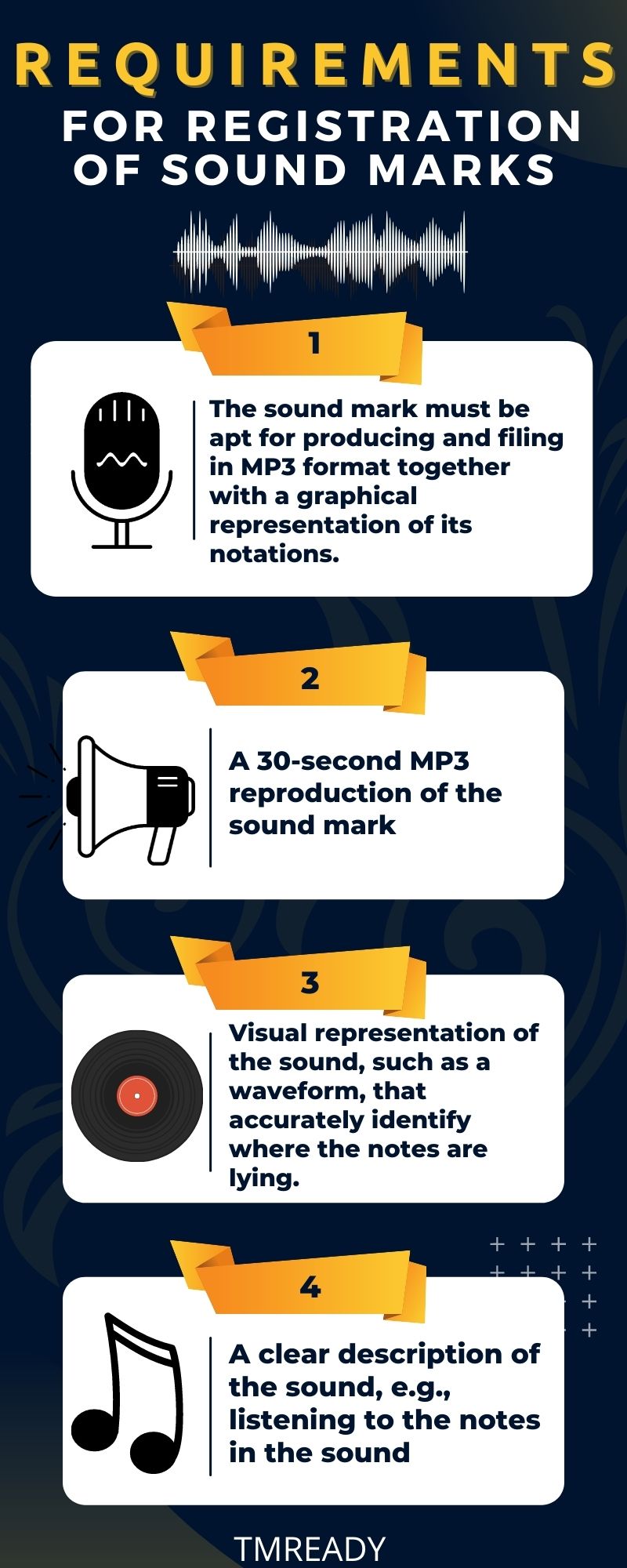
- The sound mark must be apt for producing and filing in MP3 format together with a graphical representation of its notations.
- A 30-second MP3 reproduction of the sound mark
- A visual representation of the sound, such as a waveform or a note sheet or musical notations that accurately identify where the notes are lying.
- A clear description of the sound, e.g., listening to the notes in the sound.
- Other formats will not be approved for registration unless there is a facility for an electronic recording of the sound on CD or DVD.
- Sound marks must have a factual distinctiveness and should not be generic in nature.
- Thus, you can also use musical notes to graphically depict a sound mark in India, simplifying the trademark registration procedure.
Also Read: A-Z Guide to Trademarks in 2022
Sound Marks Registration Process in India
The registration process for a sound trademark is the same as it is for any other trademark, including device mark, logo mark, etc. The steps are as follows:
1. Perform A Trademark Search
A trademark availability search for identical or similar sound marks will help you determine whether any existing trademarks are similar to the one you’d like to register. Moreover, it will also determine if the requested trademark is already in use.
2. Application Submission
The applicant must apply to the Trade Marks Registry in India. Before submission, make sure that:
- The proposed sound mark is not generic in nature
- There are no similar marks registered or in use that may confuse the consumers
- Your application for registration is complete and consists of all the required documents and details, such as musical notes, trademark class, etc.
3. Examination
The trademark examiner at the Trade Marks Registry will scrutinize a trademark application for any problems after its submission. The trademark may be accepted conditionally or objected to by the examiner.
4. Publication In The Trademark Journal
If the trademark examiner finds no issues with your sound mark registration application, he/she will approve the application for publication in the Trademark Journal.
5. Opposition
Anyone can oppose the sound mark after its publication in the journal. Here, there exist 2 possibilities:
- If there is no objection within 3-4 months of publication, the trademark goes ahead for registration.
- In there is an opposition, the Registrar holds a fair hearing and decides. But if the other party wins the hearing, the examiner may reject the trademark application.
5. Registration
Following the completion of the preceding processes, the Trade Marks Registry Office registers the sound mark.
What Is The Life Of Sound Marks in India?
Like other trademarks, sound marks are valid for 10 years after registration. Then, it would be best if you renew your sound mark after expiry to continue their further usage.
Government Fees for Sound Mark Registration in India
| Category | Fees For Sound Mark Registration |
| Individuals/ Small Enterprises/ Startups | INR 4,500 to INR 5,000 |
| All Other Categories | INR 9,500 to INR 10,000 |
Sound Marks & Related Cases
As the trend for sound marks is still in the infant stage in India, there have not been any sound marks cases in India. However, the scenario is quite different in countries like the USA, UK, Canada, etc.
For example, the market for intellectual properties, including sound marks, is at an advance stage in the USA. Not only have hundreds of good marks registered at USPTO (you can access the list and even listen to the registered sound marks here), but also equally high are the oppositions and cases. One of the best examples in this regard would be Harley-Davidson application for their V-twin engine exhaust sound as a sound mark in 1994. After years of hearing due to 9 oppositions, the company dropped the registration application midway.
What Are The Benefits of Sound Marks?
- Due to sound trademark protection, the ability to prevent any third party from abusing the registrant’s sound mark rights.
- The main benefit of registering a trademark is that it gives you exclusive rights to the mark. This means you’ll be the only one in the country to launch or sell items or services bearing the same brand name.
- The monopoly over statutory rights connected with securing trademark registrations for sound marks is a clear benefit.
- The proper enforcement of a registrant’s right in a mark guarantees that unauthorized third parties do not take advantage of the mark’s goodwill and reputation and that the (sound) mark does not become diluted.
- Sound mark registrations are renewable regularly to guarantee that the registrant receives sufficient compensation for the time and effort invested in developing the sound mark.
FAQs
Can sounds be trademarked in Canada?
Yes, under the Canadian Intellectual Property Law, you can register sound marks with CIPO in the same way as other types of trademarks (logo, device). As a result, during a ten-year renewable period, the owner of a sound mark will have the exclusive right to reproduce the sound for their purposes commercially.
Is the lightsaber sound trademarked?
Yes, by Lucasfilm. The noises that lightsabers make while wielded, retracted, and swung are another distinguishing feature of sound registered by Lucasfilm.
Is Darth Vader breathing copyrighted?
Darth Vader’s breathing is trademarked as a sound mark, not copyrighted. But the Darth Vader masks are not trademarked.
Is Harley-Davidson sound trademarked?
No, the company tried to register a sound mark for the unique Harley-Davidson sound in 1994. But guess what followed? 9 oppositions and 6 long years of litigation. Result? The company dropped its sound mark registration application midway. But the Harley -Davidson name, their H-D bar and shield logo, related logo names, logos, product and service names, designs, and slogans are all trademarked.
Want to Secure a Sound Mark for Your Brand? Let Us Help You Tune In.
Navigating the sound mark registration process can be challenging, especially with its unique requirements and limited guidance available. As a distinctive and unconventional form of trademark, sound marks require a careful approach to ensure successful registration.
At TMReady, we simplify the process. With decades of experience in intellectual property services, we are your trusted partner for all things trademark. Our trademark services include:
- Professional Trademark Search Services— thorough and detailed searches across multiple regions to ensure your logo is protected.
- International Trademark Search — thorough and detailed searches in over 190+ countries.
- Reliable Trademark Monitoring Services — keeping an eye on your trademark to detect potential infringements or safeguard unconventional trademarks.
All of our services are designed to offer excellent value, with competitive and cost-effective pricing.
More Related Articles
Most Important Patent Drawing Rules for 2022
Patent Application Proofreading Steps to Make Error Free Patent